Don't put diesel fuel in your tea.
Do put water in your tea, and steep for 3-8 minutes, depending on the type and quality of your tea.
Don't put antifreeze in your tea. It may taste sweet, but it'll make you die.
Do put sugar or honey in your tea (or don't, depending on your preference).
Don't put your hand in tea you have just finished steeping. It will scald you.
Do put a spoon in your tea to stir with.
Don't put an aging hippie in your tea.
Do put your tea in an aging hippie.
Don't put abstract concepts involving quanta and probability in your tea.
Do put fruit in your tea (unless you're not into that sort of thing).
Don't put fish in your tea.
Do eat fish with your tea.
Don't put aluminum utensils in your tea (or drink from an aluminum container); it will leech into your tea and possibly contribute to a number of degenerative diseases.
Do put wooden, stainless steel, titanium, stone, ice, and silicon utensils in your tea.
And lastly, don't put anything in your tea you'd be afraid to consume or use otherwise.
Showing posts with label Tea basics. Show all posts
Showing posts with label Tea basics. Show all posts
Friday, April 17, 2009


Monday, April 13, 2009
Tannins
A number of years ago I went to a Chinese restaurant with a friend, and at this particular restaurant the first thing they do after bringing you a menu is bring you a pot of hot Chinese black tea. I've always loved it, and before I got into tea I thought it had to be something radically different because none of the bagged teas (which are almost always Indian tea) I'd tried tasted as smooth and non-astringent as it. Now I realize it's a rather weak, flavorless cup of tea, but I digress.
Anyway, this friend did not drink tea. He was Mormon, so that was the reason why, but he attempted to justify it by this line of logic: tea has tannins, and tannins are used to tan leather, therefore tea must tan your insides. A lot of people have this misconception, or at least the part where tea contains tannic acid, the same substance used to tan leather.
It does not. Tea does contain tannins, which are a diverse group of polyphenols, but not tannic acid, which is extracted from oak leaves and has an entirely different chemical structure. Not all polyphenols are tannins, but all tannins are polyphenols, and as we all know, the best constituents of tea are polyphenols. Basically, a tannin is any polyphenol that shrink proteins or bind them together and cause water to evaporate off them. Any chemists or biologists reading this should correct me if I'm wrong—I got that last bit off Wikipedia earlier today.
Tannins are responsible for the astringency of low-quality or oversteeped teas, basically. Most fruits or veggies that causes your mouth to pucker up and feel like it's been dried out are high in tannins. This is why tisanes like rooibos or chamomile don't succumb to this effect when you steep them for a long time: no tannins. If teas didn't have tannins, it's very likely there wouldn't be concept of second and third steepings, because we'd just steep them as long as wBlogger: Tead Off: The Tea Blog - Create Poste wanted. White tea is the exception here, as it is relatively low in tannins, though lower quality varieties will get bitter if you steep them for too long, and most will become at least a little astringent if steeped for more than 5-8 minutes.
Tannins are good and bad for you. They are not poisonous like tannic acid, and there is absolutely no way you could ever tan leather using tannins from tea or any of the other foods and beverages we regularly ingest. First, the good, because that's what we all want to hear:
And now the bad:
Basically, moderation is good. If you're worried about anemia or other mineral deficiencies, just don't drink tea while you eat (but if you've heard adding milk keeps the tannins at bay you've been lied to—milk does nothing and may even prevent your body from utilizing the tea's antioxidants). Or add some lemon juice or vitamin C to your tea.
In any case, the most compelling argument for tannins being either benign or benevolent is the fact that tea is the world's oldest beverage other than water, and that if it were actually harmful we'd probably know about it by now. So drink up.
Anyway, this friend did not drink tea. He was Mormon, so that was the reason why, but he attempted to justify it by this line of logic: tea has tannins, and tannins are used to tan leather, therefore tea must tan your insides. A lot of people have this misconception, or at least the part where tea contains tannic acid, the same substance used to tan leather.
It does not. Tea does contain tannins, which are a diverse group of polyphenols, but not tannic acid, which is extracted from oak leaves and has an entirely different chemical structure. Not all polyphenols are tannins, but all tannins are polyphenols, and as we all know, the best constituents of tea are polyphenols. Basically, a tannin is any polyphenol that shrink proteins or bind them together and cause water to evaporate off them. Any chemists or biologists reading this should correct me if I'm wrong—I got that last bit off Wikipedia earlier today.
Tannins are responsible for the astringency of low-quality or oversteeped teas, basically. Most fruits or veggies that causes your mouth to pucker up and feel like it's been dried out are high in tannins. This is why tisanes like rooibos or chamomile don't succumb to this effect when you steep them for a long time: no tannins. If teas didn't have tannins, it's very likely there wouldn't be concept of second and third steepings, because we'd just steep them as long as wBlogger: Tead Off: The Tea Blog - Create Poste wanted. White tea is the exception here, as it is relatively low in tannins, though lower quality varieties will get bitter if you steep them for too long, and most will become at least a little astringent if steeped for more than 5-8 minutes.
Tannins are good and bad for you. They are not poisonous like tannic acid, and there is absolutely no way you could ever tan leather using tannins from tea or any of the other foods and beverages we regularly ingest. First, the good, because that's what we all want to hear:
- Tannins cause the lining of the intestinal walls to constrict, making them a good remedy for diarrhea, in addition to a number of other inflammatory bowel conditions.
- They also help heal wounds by forming a protective layer around the abrasion and by helping stop bleeding.
- Tannins are anti-microbial, and have also shown antiviral and anticancer potential in tests.
And now the bad:
- Tannins inhibit the body's ability to absorb minerals such as iron. This can lead to anemia. If you eat a lot of red meat you probably don't have to worry as iron from animal sources absorbs very readily, though you should be worried about other things instead if you're a red meat freak...
- Some people may have gastro-intestinal troubles if they ingest a lot of tannins.
- Tannins have been linked to cancer, though tea has not been, so don't worry about this one unless you take a lot of astringent herbs
Basically, moderation is good. If you're worried about anemia or other mineral deficiencies, just don't drink tea while you eat (but if you've heard adding milk keeps the tannins at bay you've been lied to—milk does nothing and may even prevent your body from utilizing the tea's antioxidants). Or add some lemon juice or vitamin C to your tea.
In any case, the most compelling argument for tannins being either benign or benevolent is the fact that tea is the world's oldest beverage other than water, and that if it were actually harmful we'd probably know about it by now. So drink up.
Tuesday, April 7, 2009
Oxidation vs. Fermentation
Just a quick note and nit: when people talk about black or oolong teas being "fermented," they are using the wrong word. There is no fermentation in the production of tea. Fermentation is used in alcohol production and anything else where energy is produced in anaerobic conditions (like in your muscles or compost heap). Tea does not undergo a process like this at all. Tea is oxidized, where essentially oxygen is allowed to change the molecular structure of the leaves and produce black and oolong teas (and even white teas, sometimes).
I just thought I'd clear the air on this. It's been bothering me lately. I received a catalog in the mail for an herb company I often buy from, and they also sell some tea products. They had a jasmine green tea and said the jasmine leaves were fermented with the tea leaves. First of all, green tea isn't oxidized, but since I like the company I can forgive them that specific offense. But the usage of the term "fermentation" is a crime committed by many a tea retailer, and I will not stand for it!
I just thought I'd clear the air on this. It's been bothering me lately. I received a catalog in the mail for an herb company I often buy from, and they also sell some tea products. They had a jasmine green tea and said the jasmine leaves were fermented with the tea leaves. First of all, green tea isn't oxidized, but since I like the company I can forgive them that specific offense. But the usage of the term "fermentation" is a crime committed by many a tea retailer, and I will not stand for it!
Sunday, August 31, 2008
Sweeteners
What kind of sweetener you use in your tea (if any) can be a very important decision. Generally, you only want a touch of sweetener in your tea to bring out the flavor and soften any bitterness that may be present. An exception to this is chai tea, as you may need somewhat more to bring out the flavor of all the spices.
Still, there are many sweeteners out there and they can greatly affect your beverage.
White sugar is, of course, the sweetener most people are familiar with. It doesn't really do anything to the flavor of your tea beyond making it sweeter. I avoid it, but only because it's refined and processed and all that crap most people don't care about.
Raw sugar will sweeten your tea just the same as white sugar, but it may add a faint molasses taste, and being that it's not processed as much, is marginally better for you than white sugar. Brown sugar is slightly less sweet because it isn't as dense, but it will definitely affect the flavor of your tea.
Honey is a popular sweetener given how much it rocks. It's much better for you than sugar, as it contains minerals, antioxidants, and has antibiotic properties. Raw honey is even better and may help alleviate one's pollen allergies. Once you get into honey, you'll find there are actually many different kinds of honey, but I'll go into that in a later article.
A less popular but totally awesome sweetener is agave nectar. I've seen it come in amber and light varieties—I've only tried the amber, and I love it. It's much runnier than honey, which means it dissolved a hell of a lot easier, and to boot it's also somewhat sweeter than sugar (while honey is slightly less sweet), meaning it takes less to reach your desired sweetness. It's also mostly fructose, which means it has an extremely low glycemic load (the lowest of all non-artificial sweeteners, I believe).
Corn syrup is no good. Avoid it. Molasses I have not tried, but I think it would be too strongly flavored to complement tea well.
Artificial sweeteners are crap and are bad for you. Avoid them.
Use Stevia if you don't want any calories (even though a tiny dollop of honey will only be 5-15 calories). Stevia is actually banned for use as a sweetener in the U.S., but is available as an "herbal supplement." I don't see how that follows, so I can only assume the sugar industry has been giving some government officials pretty sweet deals. Although be forewarned: Stevia's sweetness is a little different than that of sugar's. It's not bad, but it does take some getting used to, as it has a stronger and longer-lasting aftertaste than sugar.
And, of course, you can always just take your tea without any additives, although I prefer just a tiny touch of honey, agave nectar, or raw sugar. Just a small dot on a teaspoon is all.
Still, there are many sweeteners out there and they can greatly affect your beverage.
White sugar is, of course, the sweetener most people are familiar with. It doesn't really do anything to the flavor of your tea beyond making it sweeter. I avoid it, but only because it's refined and processed and all that crap most people don't care about.
Raw sugar will sweeten your tea just the same as white sugar, but it may add a faint molasses taste, and being that it's not processed as much, is marginally better for you than white sugar. Brown sugar is slightly less sweet because it isn't as dense, but it will definitely affect the flavor of your tea.
Honey is a popular sweetener given how much it rocks. It's much better for you than sugar, as it contains minerals, antioxidants, and has antibiotic properties. Raw honey is even better and may help alleviate one's pollen allergies. Once you get into honey, you'll find there are actually many different kinds of honey, but I'll go into that in a later article.
A less popular but totally awesome sweetener is agave nectar. I've seen it come in amber and light varieties—I've only tried the amber, and I love it. It's much runnier than honey, which means it dissolved a hell of a lot easier, and to boot it's also somewhat sweeter than sugar (while honey is slightly less sweet), meaning it takes less to reach your desired sweetness. It's also mostly fructose, which means it has an extremely low glycemic load (the lowest of all non-artificial sweeteners, I believe).
Corn syrup is no good. Avoid it. Molasses I have not tried, but I think it would be too strongly flavored to complement tea well.
Artificial sweeteners are crap and are bad for you. Avoid them.
Use Stevia if you don't want any calories (even though a tiny dollop of honey will only be 5-15 calories). Stevia is actually banned for use as a sweetener in the U.S., but is available as an "herbal supplement." I don't see how that follows, so I can only assume the sugar industry has been giving some government officials pretty sweet deals. Although be forewarned: Stevia's sweetness is a little different than that of sugar's. It's not bad, but it does take some getting used to, as it has a stronger and longer-lasting aftertaste than sugar.
And, of course, you can always just take your tea without any additives, although I prefer just a tiny touch of honey, agave nectar, or raw sugar. Just a small dot on a teaspoon is all.
Monday, August 18, 2008
Tea Bags
Most Americans are only familiar with tea bags, as they are convenient, don't require you to own a teapot or infuser, and come in pretty little boxes. I always liked the Celestial Seasonings Sleepy Time box with the bear on it. The sleepy bear. Granted, bears tend to be more dangerous when they're tired, but that's besides the point.
The point here is that if your tea comes in a bag like the one to the right, you are drinking crappy tea.
Tea bags are filled not with whole leaf tea that produces a superior brew, but with what are called "fannings" and "dust." These are also known as "floor sweepings." Floor sweepings are the smallest particles of tea produced, and are often simply left over from whole leaf production. They tend to produce a cup of tea that has a deep color, but a really terrible flavor, often very bitter and astringent. Whereas with whole leaf tea this occurs when you steep your tea improperly, it almost always happens with tea bags.

The above are your typical teabag. Most mainstream bags you'll find in the store are like this. There are also circular bags, as in the picture on the right. The idea behind them is that a circular shape will allow the tea particles more exposure to water. I confess I have some of these in my office (loose leaf tea is too hard to deal with usually). If you MUST use this kind of tea bag, go with a more respected brand like Republic of Tea.
Finally, there are pyramidal tea bags. These are rather new and aren't actually too bad. They tend to have bigger pieces of tea leaf in them and seem to produce a better cup of tea. However, most are made of nylon, which doesn't biodegrade and is made from fossil fuels, so look for bags made from silk.
Of course, the best bagged tea of all is the kind you stick in a bag yourself. One can buy disposable tea infusers and simply load their tea for later use.
As a sidenote, bagged tisanes typically aren't inferior to the loose varieties, so you can still buy that awesome Sleepy Time tea with the bear on the box.
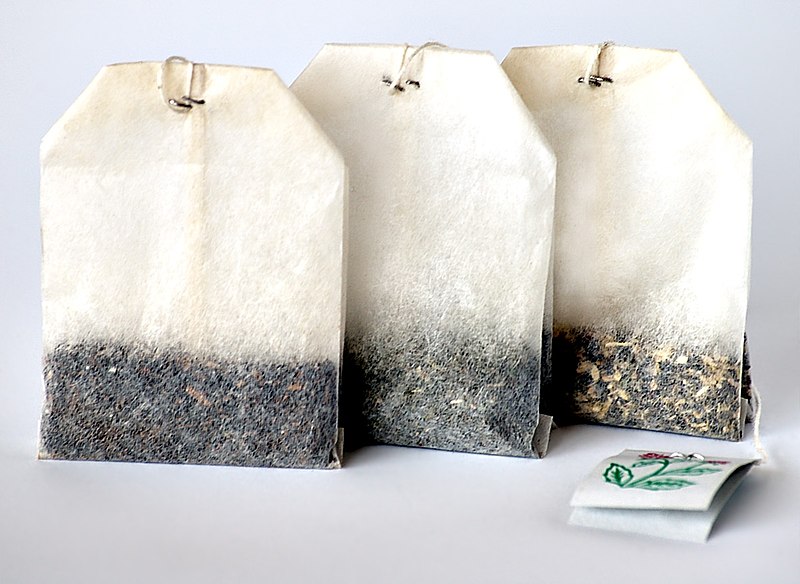
The point here is that if your tea comes in a bag like the one to the right, you are drinking crappy tea.
Tea bags are filled not with whole leaf tea that produces a superior brew, but with what are called "fannings" and "dust." These are also known as "floor sweepings." Floor sweepings are the smallest particles of tea produced, and are often simply left over from whole leaf production. They tend to produce a cup of tea that has a deep color, but a really terrible flavor, often very bitter and astringent. Whereas with whole leaf tea this occurs when you steep your tea improperly, it almost always happens with tea bags.

The above are your typical teabag. Most mainstream bags you'll find in the store are like this. There are also circular bags, as in the picture on the right. The idea behind them is that a circular shape will allow the tea particles more exposure to water. I confess I have some of these in my office (loose leaf tea is too hard to deal with usually). If you MUST use this kind of tea bag, go with a more respected brand like Republic of Tea.
Finally, there are pyramidal tea bags. These are rather new and aren't actually too bad. They tend to have bigger pieces of tea leaf in them and seem to produce a better cup of tea. However, most are made of nylon, which doesn't biodegrade and is made from fossil fuels, so look for bags made from silk.
Of course, the best bagged tea of all is the kind you stick in a bag yourself. One can buy disposable tea infusers and simply load their tea for later use.
As a sidenote, bagged tisanes typically aren't inferior to the loose varieties, so you can still buy that awesome Sleepy Time tea with the bear on the box.
Thursday, August 14, 2008
Caffeine in Tea
There's a lot of information about tea floating around out there. Some sites on the internet may proclaim that tea cures Alzheimer's Disease, friends may go on about green tea's ability to make one grow younger, news articles may purport that tea extracts cured a lab rat's dental plaque. And for even experienced tea drinkers, determining what's bullshit and what's factual can be a chore.
Here's one of the most common factoids about tea.
Black tea, due to its oxidation, has the highest levels of caffeine of all tea types. Oolong teas have roughly 2/3 the caffeine of black tea, green teas have roughly 1/3, and white teas have even less than green tea. As a rule of thumb, the less processed a tea is, the less caffeine it will have.
Many tea drinkers take this to be a given. I know I did until recently. But in actuality, it's not true.
There is some truth to this myth, however. Green tea is typically brewed with fewer leaves than black tea, which means a cup of black tea will often have more caffeine than a cup of green tea (but not always).
What tipped me off was white tea. I've heard that white tea has very little caffeine and that it has almost as much as black tea. I did some research and found out that I'd been living a lie -- the green tea I often drink a few hours before bed was indeed what we keeping me up. And now I can't turn to white tea, because it apparently has caffeine levels similar to green tea, if not somewhat higher.
The good news is that tea still has much less caffeine than coffee, and that the caffeine in tea is less likely to give you the jitters. The caffeine is chemically the same as that in coffee, but the polyphenols in tea bind to the caffeine which results in not all of it being released into your system at once. Tea also contains L-theanine, an amino acid that calms and relieves stress.
So if you're particularly sensitive to caffeine, you may want to buy decaffeinated tea instead of substituting green or white tea for black and oolong tea.
Here's one of the most common factoids about tea.
Black tea, due to its oxidation, has the highest levels of caffeine of all tea types. Oolong teas have roughly 2/3 the caffeine of black tea, green teas have roughly 1/3, and white teas have even less than green tea. As a rule of thumb, the less processed a tea is, the less caffeine it will have.
Many tea drinkers take this to be a given. I know I did until recently. But in actuality, it's not true.
"All teas have roughly similar caffeine contents, and one cannot rely on the belief that green tea has less caffeine, as asserted by many popular claims. One such claim is that degree of fermentation governs caffeine content, with green having 1/3 and oolong having 2/3 the caffeine content of black tea. This has been debunked repeatedly."Basically, caffeine content is dictated by the genetic makeup of the tea plant. Some varieties have more caffeine than others, and also various other factors (such as which leaves are plucked, the season, fertilizer, etc.), but oxidation of the leaves does not contribute very much caffeine to the tea, which runs contrary to popular belief.
There is some truth to this myth, however. Green tea is typically brewed with fewer leaves than black tea, which means a cup of black tea will often have more caffeine than a cup of green tea (but not always).
What tipped me off was white tea. I've heard that white tea has very little caffeine and that it has almost as much as black tea. I did some research and found out that I'd been living a lie -- the green tea I often drink a few hours before bed was indeed what we keeping me up. And now I can't turn to white tea, because it apparently has caffeine levels similar to green tea, if not somewhat higher.
The good news is that tea still has much less caffeine than coffee, and that the caffeine in tea is less likely to give you the jitters. The caffeine is chemically the same as that in coffee, but the polyphenols in tea bind to the caffeine which results in not all of it being released into your system at once. Tea also contains L-theanine, an amino acid that calms and relieves stress.
So if you're particularly sensitive to caffeine, you may want to buy decaffeinated tea instead of substituting green or white tea for black and oolong tea.
Monday, August 11, 2008
Herbals Teas & Tisanes
Many people enjoy "herbal tea," though this is a bit of a misnomer, as tea is a specific plant, Camellia sinensis. Herbal teas, more accurately, are called "tisanes," which is any kind of non-tea infusion of dried plant matter. Most do not confer the same health benefits as tea, although many have benefits of their own.
Many, such as peppermint, are often added to tea. Others such as rooibos and chamomile are typically made on their own. But like tea, care should be taken not to steep tisanes for too short or too long a time. Mint tisanes will become bitter and astringent like tea if oversteeped, while others like chamomile can become too strongly flavored to be pleasant.
One of the more popular ones, Rooibos, is often referred to as "red tea." Again, this is a misnomer, as Rooibos is an entirely different plant. As far as tisanes go, however, it's one of the more healthy ones. Rooibos has many of the same antioxidants as tea, as well as a few that tea doesn't have, although few studies have been performed on the efficacy of them.
If you drink tea for its health benefits, then you should stick to actual teas. There's nothing wrong with a good tisane, however, and if you enjoy the taste there's no reason not to have one.
Many, such as peppermint, are often added to tea. Others such as rooibos and chamomile are typically made on their own. But like tea, care should be taken not to steep tisanes for too short or too long a time. Mint tisanes will become bitter and astringent like tea if oversteeped, while others like chamomile can become too strongly flavored to be pleasant.
One of the more popular ones, Rooibos, is often referred to as "red tea." Again, this is a misnomer, as Rooibos is an entirely different plant. As far as tisanes go, however, it's one of the more healthy ones. Rooibos has many of the same antioxidants as tea, as well as a few that tea doesn't have, although few studies have been performed on the efficacy of them.
If you drink tea for its health benefits, then you should stick to actual teas. There's nothing wrong with a good tisane, however, and if you enjoy the taste there's no reason not to have one.
Types of Tea
While professional tea-drinkers no doubt already know all the different varieties of tea, many newer tea drinkers are surprised to find there's more out there than green and black teas. All teas come from the same plant, but they can differ from one another tremendously due to how they're processed.
Most are familiar with black tea, which is the most processed of the types of tea. Leaves are typically picked, fried, and then oxidized. No one's really sure why people began oxidizing their tea, but it probably had to do with preservation, as black teas keep a lot longer than less processed teas.
Oolong teas are not quite as processed as black teas, but are moreso than green tea. Actually, oolong teas are very diverse--some taste almost like black tea, some almost like green tea. Oolong teas undergo the oxidation process like black teas, but the process is stopped somewhere in between.
Green teas are picked, steamed to remove enzymes that promote oxidation, dried, and then rolled. They tend to have a grassy flavor, and also tout some of the best health benefits of all teas.
White teas undergo the least processing. White tea comes from the buds of the tea plant before they develop large amounts of chlorophyll, and undergo immediate steaming to break down those oxidizing enzymes. White teas often have a faint sweetness to them, with none of the grassiness of green tea.
Of course this is all very basic. Even within tea types there can be major differences. A cup of Assam is very different from a Golden Yunnan, White Peony is very different from Silver Needle white tea, and there are marked differences between Japanese and Chinese green teas.
As a general guideline, the more processed a tea is, the higher temperature water you use and the longer you steep it, although with high quality, expensive teas this doesn't necessarily apply. Brewing the wrong way can result in a weak, tasteless cup of tea or a brew that is too astringent and bitter to stomach.
Most are familiar with black tea, which is the most processed of the types of tea. Leaves are typically picked, fried, and then oxidized. No one's really sure why people began oxidizing their tea, but it probably had to do with preservation, as black teas keep a lot longer than less processed teas.
Oolong teas are not quite as processed as black teas, but are moreso than green tea. Actually, oolong teas are very diverse--some taste almost like black tea, some almost like green tea. Oolong teas undergo the oxidation process like black teas, but the process is stopped somewhere in between.
Green teas are picked, steamed to remove enzymes that promote oxidation, dried, and then rolled. They tend to have a grassy flavor, and also tout some of the best health benefits of all teas.
White teas undergo the least processing. White tea comes from the buds of the tea plant before they develop large amounts of chlorophyll, and undergo immediate steaming to break down those oxidizing enzymes. White teas often have a faint sweetness to them, with none of the grassiness of green tea.
Of course this is all very basic. Even within tea types there can be major differences. A cup of Assam is very different from a Golden Yunnan, White Peony is very different from Silver Needle white tea, and there are marked differences between Japanese and Chinese green teas.
As a general guideline, the more processed a tea is, the higher temperature water you use and the longer you steep it, although with high quality, expensive teas this doesn't necessarily apply. Brewing the wrong way can result in a weak, tasteless cup of tea or a brew that is too astringent and bitter to stomach.
Subscribe to:
Posts (Atom)